

Kangaroos are the most iconic animals with pouches and are found throughout Australia. The red kangaroo is the largest marsupial species in the world. Other common species include the eastern grey, western grey, and antilopine kangaroos.
A female red kangaroo typically gives birth to one joey at a time, and she has the ability to pause the development of a new embryo — a process called embryonic diapause — until the current joey has left the pouch.
Red kangaroo joeys spend their first 33 days entirely inside the mother’s pouch. After that, they may poke their head out or return to the pouch when frightened, continuing this behavior for about 8 more months. As they grow, their heads and feet often protrude from the pouch. Around eight months of age, the joey permanently leaves the pouch but continues nursing until about one year old.
What Does The Pouch Of A Kangaroo Looks Like
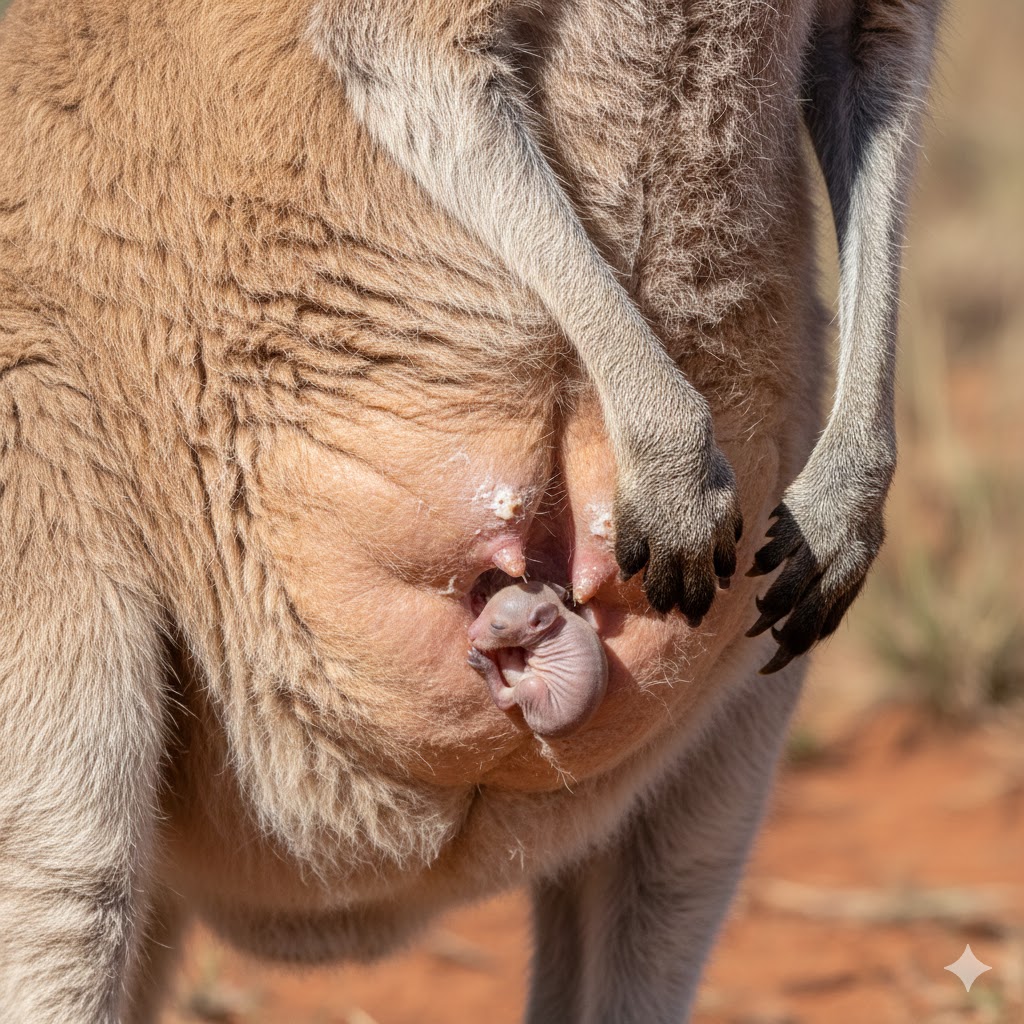
The kangaroo pouch is a flap of skin and fur that forms a deep, forward-facing pocket on the mother’s belly. Here’s how it appears from the outside:
- Shape and position: It looks like a soft, furry purse or bag hanging from the lower abdomen, opening at the top (near the mother’s chest) and extending downward. In large species like the red kangaroo, the pouch can be 30–50 cm (12–20 inches) deep when fully developed.
- Appearance when empty: In young or non-breeding females, the pouch is almost invisible—just a shallow slit covered by fur. When the female is not raising a joey, the pouch shrinks and the opening tightens.
- Appearance with a joey inside: The pouch stretches dramatically and becomes very obvious. You’ll see a bulging, rounded sack with the joey’s head, arms, or tail sometimes poking out the top. The fur around the rim is usually worn or parted from constant use.
- Color and texture: The outside is covered in the same fur as the rest of the body (gray, red, or brown depending on species). The rim of the opening has thicker, coarser guard hairs that help seal the pouch when the muscles contract.
- Muscular and dynamic: The pouch is made of strong skin and is controlled by powerful sphincter-like muscles (the cremaster and pouch muscles). The mother can tightly close the opening when swimming, hopping at high speed, or if danger is near—essentially sealing the joey inside like a biological seatbelt.
What’s It Really Like Inside a Kangaroo Pouch?
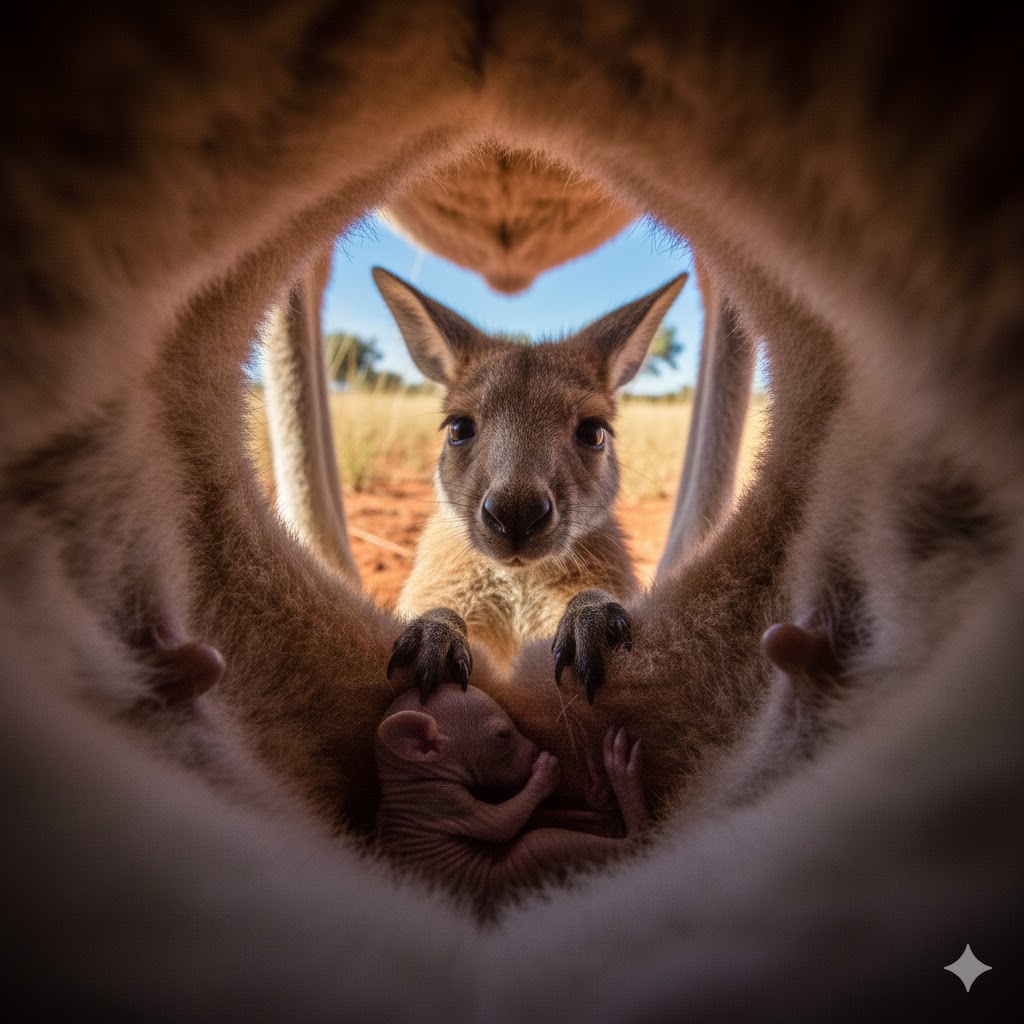
The pouch is a sophisticated, living nursery custom-built for raising extremely underdeveloped young. Here’s a detailed breakdown of what the inside is actually like, from the perspective of both the joey and the mother.
1. Physical structure and feel
- Warm and humid: The pouch maintains a steady temperature of about 36–38 °C (97–100 °F), slightly warmer than the mother’s body temperature. It’s naturally humid to prevent the joey’s delicate skin from drying out.
- Soft but tough lining: The inner surface is lined with very fine, short fur and soft skin. It feels velvety to the touch, but the skin itself is thick and leathery on the outside for protection.
- Four teats, one joey at a time (usually): There are four teats arranged in a rough semicircle. A newborn joey (pinkie) permanently latches onto one teat for months; the teat swells in its mouth so it literally cannot let go. Older siblings may poke their heads in to nurse from a different teat while a tiny new sibling is attached to another.
2. The newborn’s experience (first 6–8 months)
When a kangaroo joey is born, it’s the size of a jellybean (~2 cm, 0.8 g)—blind, hairless, with stubby forelimbs and no functioning hind legs. The journey to the pouch and life inside is surreal:
- The climb: The mother licks a wet path from birth canal to pouch. The blind newborn crawls up using its already-strong arms, taking 3–10 minutes.
- First moments inside: Pitch-black darkness, 100 % humidity, muffled sounds of the mother’s heartbeat and breathing. The joey finds a teat by smell and touch, latches on, and the teat swells to anchor it.
- Completely sealed in: For the first ~150–200 days (depending on species—red kangaroos longer, smaller wallabies shorter), the joey almost never leaves the teat. It breathes through tiny lungs while milk is pumped directly into its stomach by the mother’s teat muscles (no sucking needed at first).
- Smell: Strong musky scent from maternal skin oils and milk. The pouch has its own microbiome, and the mother regularly licks the inside clean.
3. As the joey grows (6–12 months)
- Starts poking its head out around 5–7 months (the famous “joey peeking” photos).
- The pouch becomes a jungle gym: The growing joey turns around, sticks legs out, sometimes falls out accidentally and has to hop back in.
- Temperature regulation: The mother can cool the pouch by licking her forearms and wrists (evaporative cooling) or warm it by curling around it.
- Still incredibly snug: Even at 8–10 kg (for a red kangaroo), the joey is literally wedged in head-first or feet-first depending on mood. The mother’s pouch muscles stretch dramatically but remain strong enough to keep the joey secure during 50 km/h hops.
4. Sensory experience for the joey
- Sound: Muffled thumping of mother’s hops, her heartbeat, digestive gurgles, and distant outside noise.
- Light: Almost none until the joey starts poking its head out. The pouch opening faces forward and is usually kept semi-closed.
- Movement: Constant rocking, bouncing, sudden accelerations, and the occasional full inversion when mum bends over to graze.
- Safety: Predator-proof when the pouch is closed—dingoes, dogs, and eagles can’t get in.
5. Hygiene and maintenance
- The mother cleans the pouch obsessively: She inserts her long snout deep inside and licks everything clean—removing feces, urine, and old fur.
- Joeys defecate and urinate inside the pouch for months; the mother either absorbs the liquid through the pouch lining or licks it away. (Yes, it’s as gross as it sounds, but extremely efficient.)
6. Species differences
- Red kangaroos: Deep, spacious pouch; joey stays inside ~235 days before first exit.
- Tree-kangaroos: Pouch opens upward (so baby doesn’t fall out while climbing).
- Smaller wallabies: Shallower pouch, joey emerges earlier.
In short: The kangaroo pouch is warm, dark, humid, muscular, constantly moving, smells strongly of milk and mother, and is one of the safest places on Earth for a developing marsupial. It’s less a “pocket” and more a living, breathing, self-cleaning incubator that can sprint at 60 km/h while keeping its occupant perfectly secure.
Do Male Kangaroos Possess Pouches?
Male kangaroos do not have pouches. Only female kangaroos possess pouches to carry, care for, and nurse their babies, called joeys. Female kangaroos are the main caretaker of joeys.
Male Roles: Males are not actively involved in caring for a joey. Males are usually larger and heavier and will likely protect females or joeys.
Male Anatomy: Instead of a pouch, male kangaroos have a scrotum.
No one in the world can give a loving warmth to a newborn than a mother. Joey stays inside of their mother’s kangaroo pouch for months for nutrition and development. It’s a complete nursery that a little one requires to grow and develop. Kangaroo mother care methods are used nowadays in humans newborns also, it is followed specially in the case of a low weight or premature baby, that involves prolonged skin to skin contact, crucial warmth, emotional support and breastfeeding. This method supports healthy growth and development.
Bottom Line:
In nature’s most remarkable nursery, a kangaroo pouch is far more than a pocket: it’s a warm, dark, humid, self-cleaning incubator that protects, feeds, and bounces along at 60 km/h while turning a jellybean-sized newborn into a hopping joey. Safe, snug, and powered by pure maternal genius — there’s truly no cozier place on Earth.
If this amazed you, share it with a friend, drop a 🦘 in the comments, and follow for more mind-blowing animal secrets!