

Low-histamine foods are fresh, minimally processed foods that naturally contain very little histamine. This is important because histamine can cause issues like headaches, rashes, stomach problems, or allergies in people who are sensitive to it. These foods form the foundation of a low-histamine diet, which helps reduce these reactions.
What Is Histamine and Why Do Low-Histamine Foods Matter?
Histamine is a natural chemical found both in your body and in many foods. It helps with several important functions—acting as a messenger between cells (neurotransmitter) and playing a key role in your immune system during allergies or inflammation.
However, some people have trouble breaking down histamine properly. This can happen due to:
Low activity or deficiency of the enzyme DAO, which breaks down histamine in the gut
Low activity of HNMT, an enzyme that breaks down histamine inside the body
Gut problems like SIBO, leaky gut, or imbalanced gut bacteria, which reduce DAO levels
Genetic variations affecting DAO or HNMT
Certain medications (like NSAIDs, antidepressants, or even some antihistamines) that can block DAO
When histamine builds up faster than your body can process it, symptoms may show up. These can include:
Migraines or headaches
Hives or skin rashes
IBS-like stomach issues
Anxiety or restlessness
Flushing or redness
Stuffy nose
Heart palpitations
Low blood pressure
Trouble sleeping
A low-histamine diet is usually followed for 2–6 weeks to help lower the overall “histamine load” in your body. After this phase, foods are slowly added back in to identify what specifically triggers your symptoms.
Key Principles of a Low-Histamine Diet
1. Freshness matters more than anything.
Histamine builds up in food the longer it sits — especially in cooked food, reheated meals, or leftovers.
2. Skip aged, fermented, cured, smoked, or slow-cooked foods.
These foods naturally contain high histamine or cause your body to release more of it.
3. Avoid histamine-liberating foods.
Even if some foods don’t contain much histamine, they can trigger your mast cells to release histamine — and still make symptoms worse.
4. Freeze meat and fish right away.
Freeze them immediately after buying, and cook directly from frozen when possible to keep histamine levels low.
5. Eat fresh, not leftovers.
Try to avoid leftovers older than 24 hours — even when kept in the fridge.
6. Beware of some “healthy” foods.
Foods like tomatoes, spinach, avocado, citrus fruits, strawberries, chocolate, and nuts are nutritious but can be problematic for people with histamine intolerance.
Ultimate Low-Histamine Foods List
Below is a clear, colour-coded guide to help you understand which foods are generally safer and which ones to avoid. Everyone’s tolerance is different, but this is a strong starting point.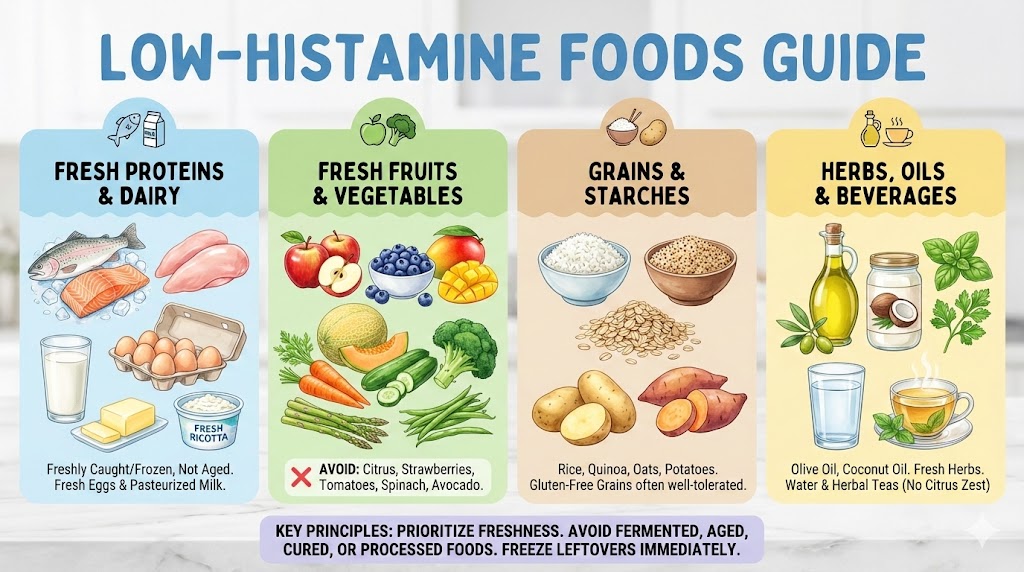
Colour Code: What Each Level Means
- ✅ 0 – Very Safe: Rarely causes issues for most people
- ✅/⚠️ 1 – Usually Safe: Well-tolerated by 80–90% of people
- ⚠️ 2 – Moderate: Could go either way — test slowly and carefully
- ❌ 3 – High Histamine / Strong Liberator: Best to avoid
- ❌❌ 4 – Extremely High: Almost always triggers symptoms
Important Rule
Rule #1: Freshness is non-negotiable — cook once, eat once.
Start with only GREEN (Very Safe) foods for 2–4 weeks.
Slowly introduce YELLOW (Usually Safe) foods — one new food every 3–4 days — while watching how your body reacts.
Low-Histamine Vegetables List
Vegetables | Rating | Histamine Level | Detailed Notes & Tips |
| Lettuce (all types) | ✅ | 0 – Very Safe | Iceberg, romaine, butterhead – perfect base salad |
| Cucumber (peeled) | ✅ | 0 | Always peel – skin can irritate |
| Zucchini / Courgette | ✅ | 0 | Best when young and firm |
| Cauliflower | ✅ | 0 | Extremely well tolerated |
| Cabbage (green, red, savoy) | ✅ | 0 | Raw or cooked – excellent |
| Carrots | ✅ | 0 | Raw or cooked |
| Sweet potato / Yam | ✅ | 0 | Top safe carb source |
| White potato (peeled) | ✅ | 0 | Peel removes potential irritants |
| Celery, Leek, Radish, Daikon | ✅ | 0 | All very safe |
| Asparagus (fresh or flash-frozen) | ✅ | 0 | |
| Broccoli (fresh, lightly cooked) | ✅/⚠️ | 1 – Usually Safe | Some react if overcooked or old |
| Onion (cooked) | ✅/⚠️ | 1 | Raw often worse; cooked usually fine |
| Garlic (fresh, small amounts) | ✅/⚠️ | 1 | |
| Beetroot (fresh, not pickled) | ✅/⚠️ | 1 | Natural nitrates can bother a minority |
| Pumpkin / Butternut squash | ⚠️ | 2 – Test Carefully | Often OK when very fresh |
| Green beans, Peas, Brussels sprouts | ⚠️ | 2 | Fresh or flash-frozen only |
| Red bell pepper | ⚠️ | 2 | Green pepper is safer |
| Corn (fresh on cob) | ⚠️ | 2 | Usually tolerated in moderation |
| Spinach, Tomato, Avocado, Eggplant, Mushrooms | ❌ | 3–4 – Avoid | Among the worst triggers |
| All fermented vegetables (sauerkraut, kimchi) | ❌ | 4 | Extremely high |
Low-Histamine Fruits List
Fruits | Rating | Histamine Level | Detailed Notes & Tips |
| Apple (Golden Delicious, Granny Smith) | ✅ | 0 | #1 safest fruit |
| Pear (fresh, firm) | ✅ | 0 | |
| Blueberries, Blackberries, Cranberries (fresh) | ✅ | 0 | Frozen at peak ripeness also safe |
| Mango (ripe but not overripe) | ✅/⚠️ | 1 | Overripe dramatically worsens |
| Pomegranate, Apricot, Peach (white), Sweet cherry | ✅/⚠️ | 1 | |
| Dragon fruit | ✅ | 0 | Extremely safe |
| Raspberries, Melon (honeydew), Kiwi | ⚠️ | 2 | Test one at a time |
| Banana (just barely ripe, no spots) | ⚠️ | 2 | Spotted/overripe = strong liberator |
| All citrus, Strawberry, Pineapple, Papaya | ❌ | 3–4 | Strong liberators + very high histamine |
| Any dried fruit | ❌ | 4 | Concentrated histamine |
Low-Histamine Meat / Poultry / Fish
Meat / Poultry / Fish | Rating | Histamine Level | Detailed Notes & Tips |
Fresh chicken, turkey (cook same day or from frozen) | ✅ | 0 | Safest proteins |
| Grass-fed beef/lamb (fresh or frozen same day) | ✅ | 0 | Never aged or hung |
| White fish (cod, hake, haddock, sole) – frozen at sea | ✅ | 0 | Gold standard for fish |
| Egg yolk | ✅/⚠️ | 1 | Most tolerate well |
| Fresh wild salmon (frozen at sea) | ⚠️ | 2 | Many still react – introduce late |
| Egg white, Pork | ⚠️ | 2 | Common liberators |
| Any aged/cured/smoked meat, leftovers >12–24 h | ❌ | 3–4 | Histamine skyrockets |
| Shellfish, canned fish | ❌ | 4 | Almost always triggers |
Low-Histamine Dairy Products list
Dairy | Rating | Histamine Level | Detailed Notes & Tips |
| Fresh mozzarella (<48 h), Ricotta, Mascarpone | ✅ | 0 | Must be extremely fresh |
| Cream cheese (no additives), Butter, Ghee | ✅ | 0 | Grass-fed best |
| Milk (if tolerated at all) | ⚠️ | 2 | Many with HIT also react to casein/A1 |
| All aged cheeses, Yogurt, Kefir, Sour cream | ❌ | 4 | Fermented = very high |
Low-Histamine Grains & Legumes
Grains & Legumes | Rating | Histamine Level | Detailed Notes & Tips |
| White & brown rice, Quinoa, Millet | ✅ | 0 | Rinse quinoa thoroughly |
| Gluten-free oats | ✅/⚠️ | 1 | Pure oats only |
| Lentils, Chickpeas (pressure-cooked) | ⚠️ | 2 | Soak + pressure cook reduces amines |
| Anything with yeast (bread, sourdough) | ❌ | 3–4 | Yeast is a major histamine source |
Low-Histamine Nuts & Seeds
| Nuts & Seeds | Rating | Histamine Level | Detailed Notes & Tips |
| Macadamia nuts | ✅/⚠️ | 1 | Lowest-histamine nut |
| Fresh chestnuts | ✅/⚠️ | 1 | Rare but very safe |
| Chia, Flax, Hemp seeds | ⚠️ | 2 | Small amounts usually OK |
| Almonds (only freshly blanched) | ⚠️ | 2 | Commercial almonds often problematic |
| Walnuts, Cashews, Peanuts, Brazil nuts | ❌ | 3 | Very high |
Low-Histamine Beverages
| Beverages | Rating | Histamine Level | Detailed Notes & Tips |
| Pure water, Rooibos, Fresh ginger/mint tea | ✅ | 0 | Safest drinks |
| Rice milk, Fresh coconut milk (no additives) | ✅/⚠️ | 1 | Check ingredients |
| Coffee (light roast, low-acid) | ⚠️ | 2–3 | Huge individual variation |
| Alcohol (all), Black/green tea, Kombucha | ❌ | 4 | Alcohol blocks DAO enzyme |
Low-Histamine Sweeteners & flavors
| Sweeteners & flavors | Rating | Histamine Level | Detailed Notes & Tips |
| Pure maple syrup, Coconut sugar, Rice syrup | ✅ | 0 | Best options |
| Fresh herbs (basil, parsley, oregano, etc.) | ✅ | 0 | Freeze in ice-cube trays for convenience |
| Pure vanilla powder (no alcohol) | ✅/⚠️ | 1 | |
| Vinegar (all), Soy sauce, Chocolate/Cocoa | ❌ | 4 | Among the strongest triggers |
| Cinnamon, Cloves, Chili, Curry powder | ❌ | 3 | Potent histamine liberators |
Important Notes & Tips About Low-Histamine Food
- Freeze meat/fish immediately if you can’t cook the same day.
- Cook once, eat once – no leftovers.
- Use glass or stainless steel instead of plastic for storage.
- Ice cube trays for portioned herbs, broth, etc.
- Many people react to “low-histamine” lists that still contain moderate triggers (e.g., broccoli, eggs, salmon). Start strict, then add back.
- DAO enzyme supplements (e.g., Seeking Health Histamine Block, Daosin) taken 10–15 min before meals can help some people re-introduce foods faster.
- Vitamin C, B6, copper, and magnesium support natural DAO production.
- Quercetin, butterbur, and stinging nettle can act as natural mast-cell stabilizers.
Read more – Can You Die From Acid Reflux in Your Sleep?
Sample Day of Eating (using only ✅ foods):
Breakfast: Gluten-free oats with fresh blueberries and rice milk.
Lunch: Cauliflower rice bowl with fresh chicken, peeled cucumber, and carrots.
Snack: Pear with a few macadamia nuts.
Dinner: Zucchini noodles with frozen-at-sea white fish, cabbage slaw, and apple slices.
A low-histamine diet is a diagnostic and short-term healing tool, not a lifelong sentence for most people. Work with a practitioner to address root causes.
Conclusion-
Embracing low-histamine foods approach can be transformative, offering relief from frustrating symptoms and reclaiming energy for daily life. By prioritizing fresh, simple foods from this guide, you’re taking a proactive step toward balance—remember, this is about empowerment, not restriction. As you experiment and heal, celebrate small wins, like a symptom-free day, and lean on professionals for personalized support. With time, root causes can be uncovered, paving the way for a more vibrant, resilient you. You’ve got this—start fresh today!