
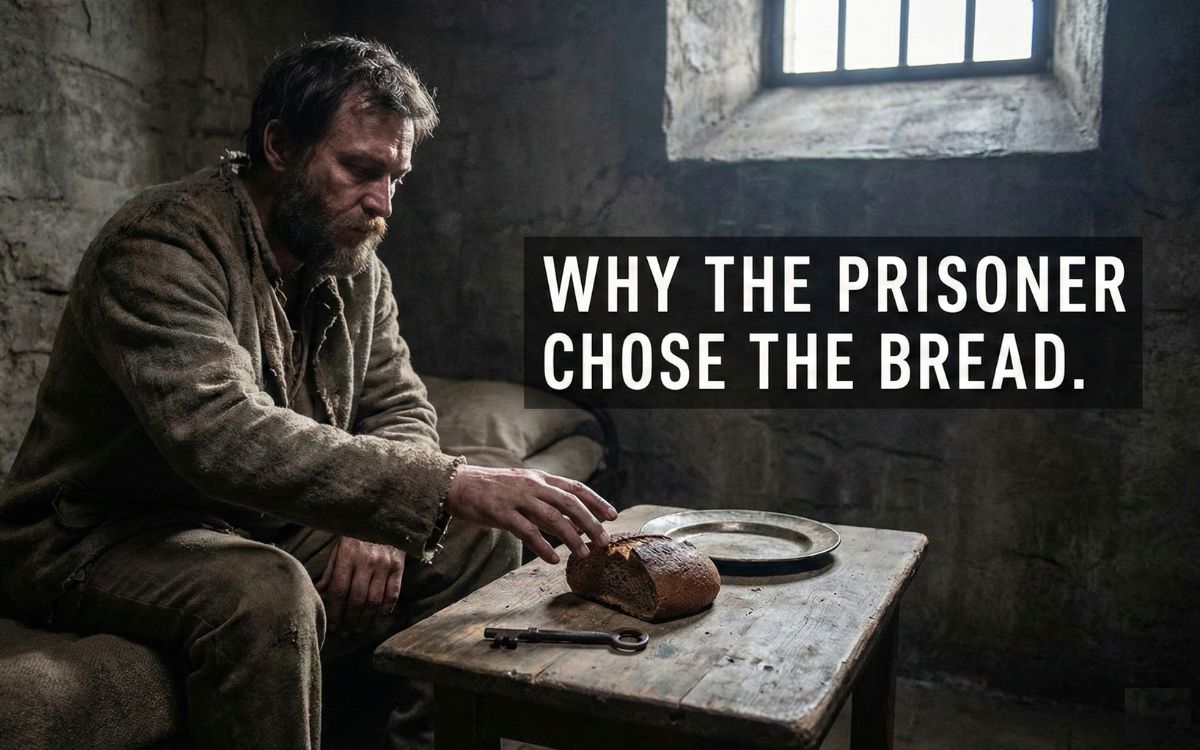
A famous quote from the classic fable “A Prisoner and the Bread.” It is a story of a prisoner who was in a cruel prison where he had not been given proper food for four years. The prisoner, locked in the cell, found two items: a loaf of bread and a key. He could choose the key and simply fly away, but he did not do that. It was quite expected that he would choose the key because it would give him freedom of life. But still, he chose bread instead of the key. Now, what can be the reason behind Why did the prisoner choose the bread instead of the key? Let’s explore the fable story, which has a deep insight and shares a strong moral value for mankind.
Story of Classic Fable
He was praying to the God to release him from the pain of hunger. God seemed to be kind to him on one fine morning and listened to his voice. A miracle happens to him. The jailer of that prison felt pity for him and came with a loaf of bread to serve him, but accidentally the key to the jail fell down from his pocket.
The prisoner thanked God that he had ultimately listened to his prayer and blessed him with food. He could satisfy his hunger in mind and stomach, for which he was dying every day. While he was just going to grab the bread in a hurry, he watched the key left by the jailer by mistake. He got confused about which one to take. It was a golden opportunity for him to get freedom for a lifetime.
The key might give him the life of a free man who can do anything as per his wish. For the time being, his mind danced with joy in the hope of freedom. He felt like he could walk, run, and spend time anywhere, anyplace, like before. But, surprisingly, he chose the bread instead of the key.
Desperate reality: Why did the prisoner choose the bread instead of the key?
Let’s explain what could be the reason behind his decision. The story of this classic fable looks simple at first glance, and the decision seems to be easier, but the truth is something else. If you think deeply, you will get the answer to this something that comes commonly in our minds. Why did the prisoner choose the bread instead of the key?
The prisoner was suffering from hunger for four long years. He was deprived of food and was left to bear the pain of hunger. A person who is not getting basic food for survival cannot imagine the goodness of freedom. Freedom seems to be a luxury if a man cannot feed his basic needs. Without food, freedom is meaningless for any person. With an empty stomach, no one can think about freedom that exactly happened to the prisoner in the classic fable story.
It was very hard for the prisoner to flee away from the cell by taking the key. He was in extreme hunger and took the loaf of bread that depicts no foolishness. There is one famous quote very well said by the famous Bengali poet Sukanta Bhattacharya: “Khudar Rajyye Prithibi Goddyomoy, Purnimar Chand Jeno Jhalsano Ruti,” which translates to English as “ Earth is prosaic in the world of hunger; the full moon seems to be burnt bread.”
So, questioning Why did the prisoner choose the bread instead of the key is groundless. What he did at that time is absolutely fine with the circumstances he was facing then. He made the correct decision, and anyone would think in the same way he thought while the jailer left his keys by mistake. The truth and reality are quite hard to accept. The story was indicating some other meaning, apparently, but if you think deeply, you will get the answer to your question: Why did the prisoner choose the bread instead of the key?
Truth of the Modern World
The story of the prisoner from the classic tale is not unfamiliar to us; you can find people even in today’s modernized world who prefer to be in jail rather than moving outside freely. Homeless people from the streets choose to stay in jail just for shelter and food. The ex-convict continuously tries to reenter the jail only to get a safe place where they can get food and shelter every day. They do this voluntarily to get peaceful sleep, medical care, hot meals, and other basic needs. The mental stress and social pressure of staying in jail do not affect them much because they are deprived of basic needs of life that are essential for surviving.
Now think of a situation where you have to do something illegal or antisocial activity voluntarily to get arrested and how difficult it could be for someone to act this way just to fulfill basic needs. A large section of homeless people in modern society intentionally indulge in minor crimes to be arrested. So, it is not only the story of the prisoner, but it is also the truth of present hardcore reality.
Final Thoughts
So far we have discussed the beautiful story of the prisoner and his decision at the time of crisis. The story has a deep connection with the real world, and it states clearly that nothing seems to be meaningful if you have hunger in your stomach. Once a person fulfills his basic needs, he can think of self-actualization. Maslow’s hierarchy of needs from humanistic psychology says the same principle. People first try to satisfy his basic needs, and then he feels the desire for other needs.
FAQ
What is the moral of the story “A Prisoner and the Bread”?
A prisoner, Bread, nicely states that a person cannot think of anything if he has hunger in his stomach. Everything seems to be meaningless if a person does not get the basic needs.
Did the prisoner make the correct decision?
Yes. The prisoner took the correct decision because he was hungry for more than four years. He was deprived of his basic rights.
Do we experience the same story of prisoners in the real world?
Yes. Current research says that there is a large section of homeless people who intentionally indulge themselves in crime to get into jail for food and shelter.