
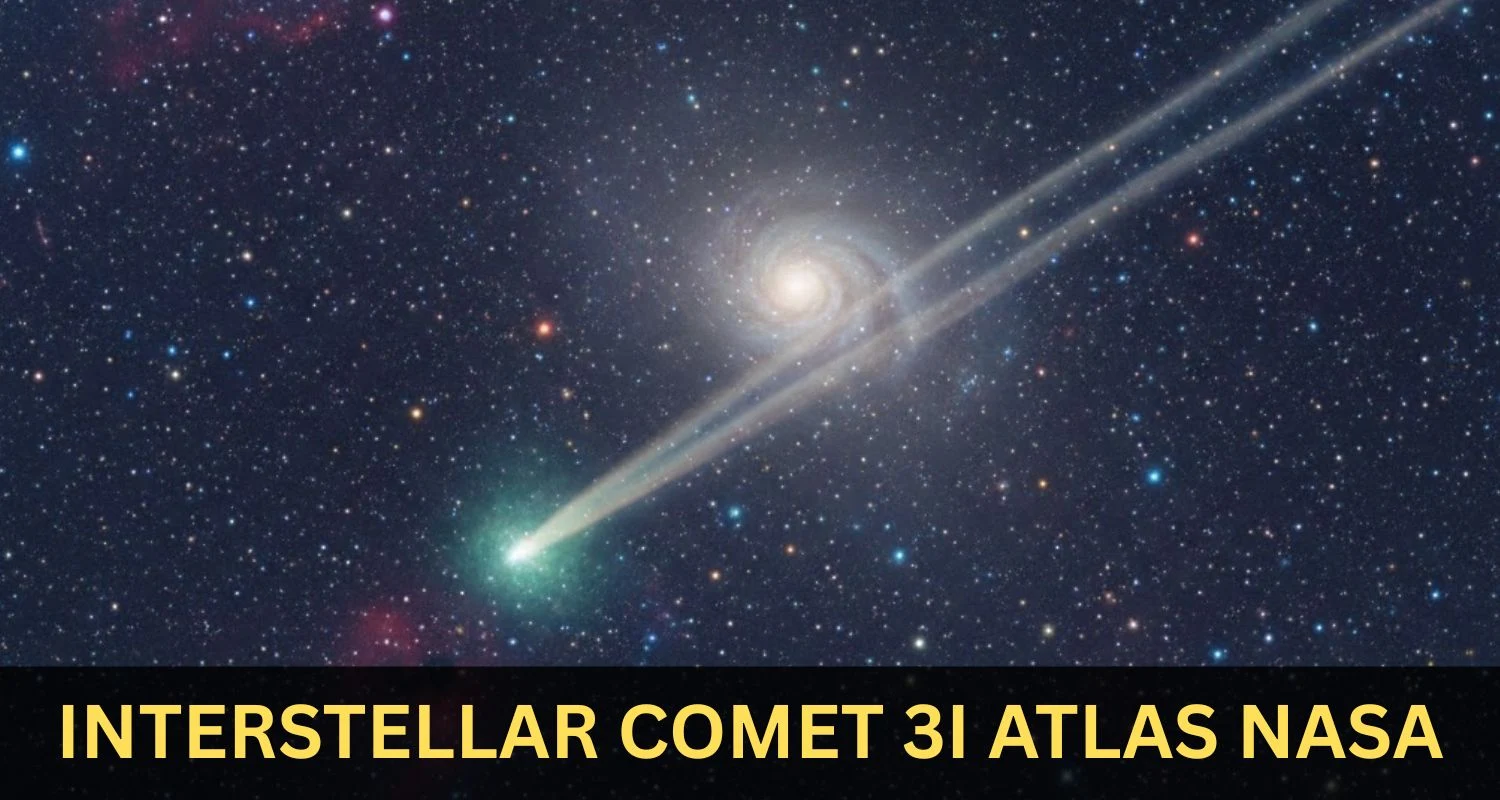
The interstellar comet 3I/ATLAS NASA has captured the attention of astronomers and space enthusiasts worldwide. Unlike ordinary comets that orbit the Sun, this visitor comes from outside our solar system, traveling across light-years of space before entering our cosmic neighborhood. Its unique trajectory and composition make it a rare opportunity to study material formed around another star.
NASA and global observatories have tracked this comet using some of the most advanced instruments ever built. Observations from spacecraft and ground-based telescopes have revealed its size, chemical composition, and behavior as it passed close to the Sun in 2025. The ATLAS NASA is providing crucial insights into the building blocks of planetary systems beyond our own.
What Is Interstellar Comet 3I/ATLAS?
The interstellar comet 3I/ATLAS NASA is the third confirmed interstellar object ever observed in our solar system. Its name reflects its discovery: “3I” means it is the third interstellar visitor, and “ATLAS” refers to the telescope that first detected it.
This comet follows a hyperbolic trajectory, meaning it is not bound by the Sun’s gravity and will eventually leave the solar system. Its path and speed confirm that it is a true interstellar visitor, offering scientists a rare look at material formed in a completely different star system.
NASA and Other Missions Tracking 3I/ATLAS
The discovery of the interstellar comet 3I/ATLAS NASA triggered a global observation campaign. Multiple NASA missions and observatories collaborated to gather as much data as possible during its passage through the solar system.
A Worldwide Observation Campaign
Once detected by the NASA-funded ATLAS survey, the comet became the focus of a coordinated effort. NASA spacecraft, including Hubble, James Webb, MAVEN, and Mars orbiters, captured detailed images and data on its coma—the cloud of gas and dust surrounding its nucleus.
These observations allowed scientists to measure its size, monitor changes in its activity, and study its composition as the Sun’s heat caused gases and dust to escape from its surface.
Europa Clipper’s Unique Ultraviolet Views
A key contribution came from NASA’s Europa Clipper mission, which used its ultraviolet spectrograph to observe 3I/ATLAS on November 6, 2025. These measurements captured gas species that are invisible to visible-light cameras, revealing the comet’s chemical makeup and the structure of its coma.
The data from Europa Clipper showed the comet’s gas and dust extending millions of miles, helping scientists understand how solar radiation interacts with interstellar comet material.
Other Spacecraft Contributions
NASA’s Psyche mission refined the comet’s trajectory using its multispectral imager, while the Mars Reconnaissance Orbiter and Perseverance rover captured images as the comet passed relatively close to Mars in October 2025. These observations provided some of the closest spacecraft views of any interstellar comet to date.
Latest Scientific Findings About 3I/ATLAS
Scientists have been closely monitoring it since its discovery to understand its composition and behavior. Observations from multiple spacecraft and telescopes have revealed unique details that set it apart from comets in our solar system.
1. Composition and Activity
The interstellar comet 3I/ATLAS NASA has a coma made of gas and dust released as sunlight warms its surface. Observations detected hydrogen atoms produced when water molecules break apart, along with carbon dioxide and other volatile compounds.
Its chemical composition differs in subtle ways from comets formed in our solar system, offering a window into how other star systems create icy bodies. Scientists are studying these differences to understand the variety of materials present in distant planetary systems.
2. Perihelion and Close Approaches
3I/ATLAS reached its closest point to the Sun, or perihelion, on October 29, 2025. Around this time, its activity peaked, producing the largest coma observed. On December 19, 2025, it made its closest approach to Earth at approximately 269 million kilometres, giving astronomers additional opportunities to study it from multiple angles.
Why 3I/ATLAS Is Important
The interstellar comet 3I/ATLAS NASA provides a unique chance to compare comets from other star systems with those in our solar system. Its chemical composition and behaviour offer insight into how planetary systems form and evolve beyond our Sun.
Studying interstellar objects like 3I/ATLAS improves models of planet formation, the distribution of water and organic materials, and the diversity of icy bodies in the galaxy. For scientists, this comet is a rare messenger from another star system.
Addressing Speculation
Despite its significance, some speculation has circulated online about 3I/ATLAS being artificial or threatening. Extensive scanning with sensitive instruments has confirmed no evidence of artificial signals or any danger to Earth.
The comet is entirely natural, and its study demonstrates the value of observation and scientific verification over rumor.
Wrapping Up
The interstellar comet 3I/ATLAS NASA is one of the most significant visitors in modern astronomy. Observations from multiple spacecraft and telescopes have provided detailed insights into its composition, behavior, and trajectory. This comet not only enriches our understanding of interstellar objects but also serves as a rare messenger from a distant star system.
For anyone following space science, 3I/ATLAS is a once-in-a-lifetime opportunity to observe the material and processes that shape worlds beyond our solar system.
Frequently Asked Questions (FAQs)
Q1. What does 3I/ATLAS mean?
It is the third confirmed interstellar object discovered, and “ATLAS” is the telescope that first detected it.
Q2. Where did 3I/ATLAS come from?
It originated from outside the solar system, travelling across interstellar space for millions of years before entering our solar system.
Q3. Is 3I/ATLAS a threat to Earth?
No. Its closest approach was far beyond Earth’s orbit, posing no danger.
Q4. Which missions observed 3I/ATLAS?
NASA’s Hubble, James Webb, MAVEN, Psyche, Europa Clipper, and Mars orbiters all contributed valuable observations.
Q5. Why is it scientifically important?
It allows scientists to study material from another star system, helping us understand how planetary systems and comets form outside our solar system.