
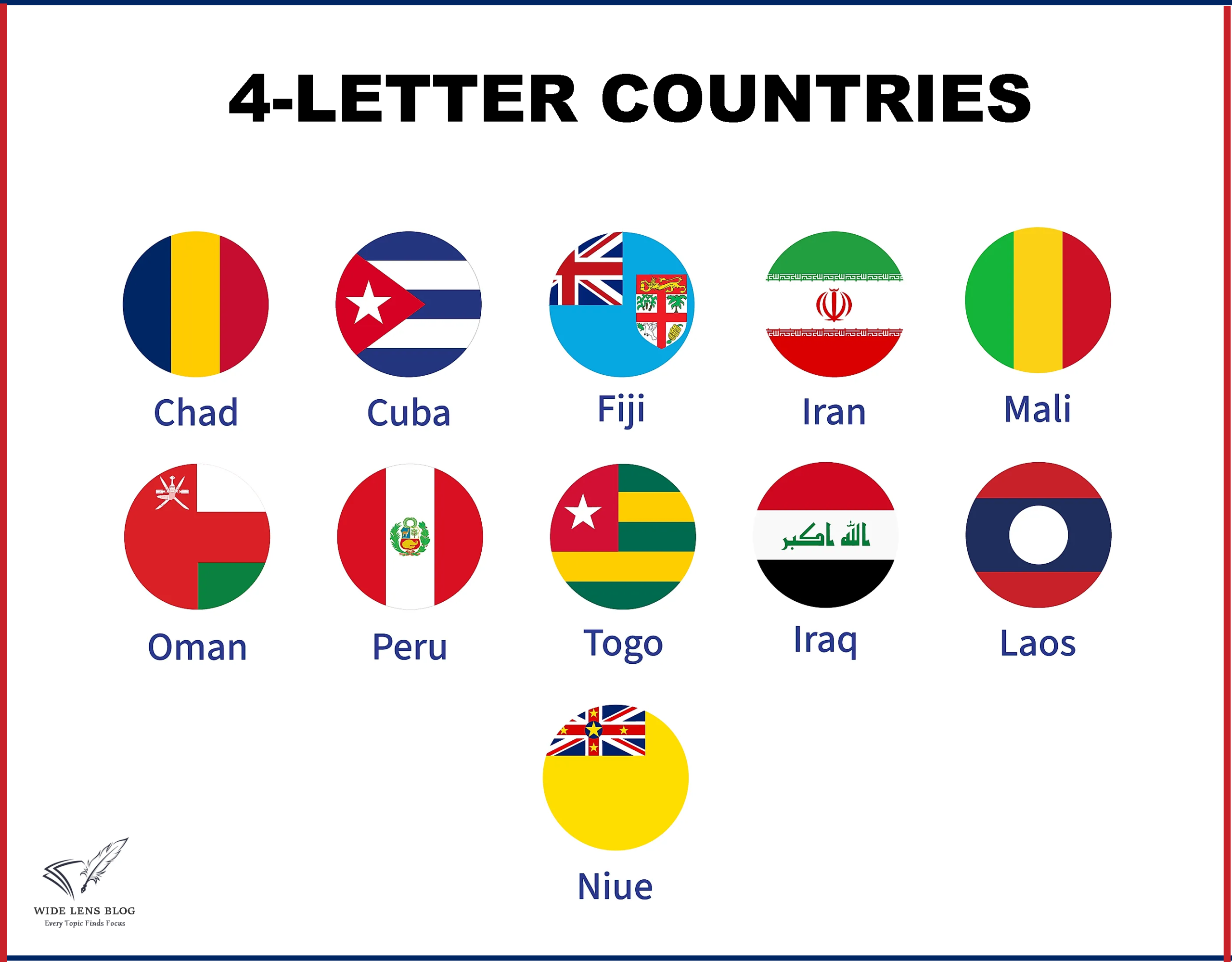
Exploring Countries with Four-Letter Names: A Simple Look at Their Geography and Culture
When we think about countries, names like the United States, Brazil, or Australia often come to mind. But what about the nations with short, snappy four-letter names? These 4-letter countries may be concise in title, but they are rich in history, culture, and global significance. In this blog, we’ll dive into the fascinating world of countries with exactly four letters in their common English names. From arid deserts to tropical islands, these nations offer a diverse tapestry of stories waiting to be explored.
Countries Whose Names are Four Letters Long
The world is home to a fascinating array of nations, and among them, a select group stands out for their concise, four-letter names. The listed names of these quad-letter nations, or tetrad-named states are their commonly used informal names, not their official formal names. For instance, Iran is formally the Islamic Republic of Iran, Oman is the Sultanate of Oman, and Laos is the Lao People’s Democratic Republic. Most countries have longer official names, but these are typically reserved for formal ceremonies, proper titles, and legal proceedings, as they can be cumbersome in everyday use.
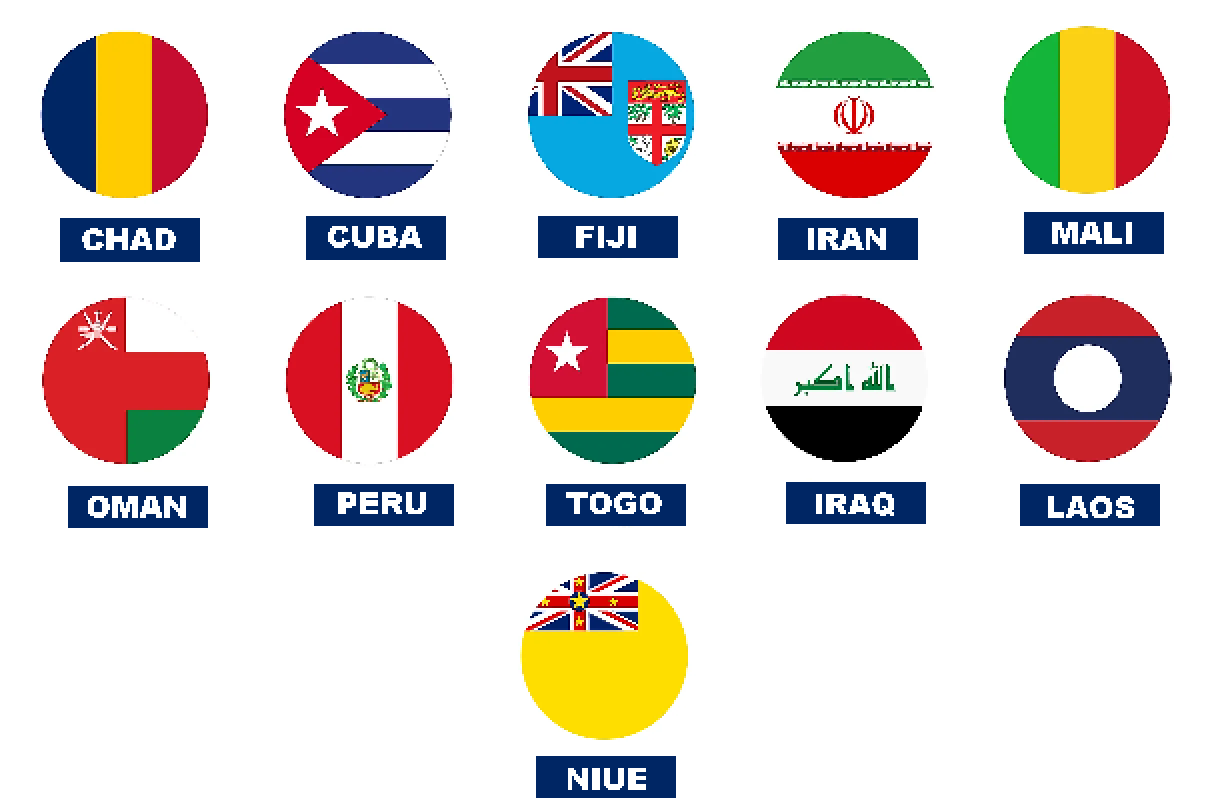
Are There Ten four letter countries or eleven?
Eleven nations—ten UN member states (Chad, Cuba, Fiji, Iran, Iraq, Laos, Mali, Oman, Peru, Togo) and Niue, a self-governing state— plus Niue, a self-governing island in free association with New Zealand, making a total of eleven. Spanning continents from Africa’s deserts to Polynesia’s coral shores, these countries weave rich histories, vibrant cultures, and unique name origins into their compact titles.
The Four Letter Countries: A Complete List
Key Facts Comparison Table
| Country | Official Name | Capital | Population (2025 est.) | Area (km²) | Currency | Official Languages |
| 🇹🇩 Chad | Republic of Chad | N’Djamena | 19,500,000 | 1,280,000 | Central African CFA franc (XAF) | Arabic, French |
| 🇨🇺 Cuba | Republic of Cuba | Havana | 11,200,000 | 110,860 | Cuban peso (CUP) | Spanish |
| 🇫🇯 Fiji | Republic of Fiji | Suva | 940,000 | 18,274 | Fijian dollar (FJD) | English, Fijian, Fiji Hindi |
| 🇮🇷 Iran | Islamic Republic of Iran | Tehran | 92,800,000 | 1,648,195 | Iranian rial (IRR) | Persian |
| 🇮🇶 Iraq | Republic of Iraq | Baghdad | 46,500,000 | 438,317 | Iraqi dinar (IQD) | Arabic, Kurdish |
| 🇱🇦 Laos | Lao People’s Democratic Republic | Vientiane | 8,000,000 | 236,800 | Lao kip (LAK) | Lao |
| 🇲🇱 Mali | Republic of Mali | Bamako | 22,600,000 | 1,240,192 | West African CFA franc (XOF) | Bambara (lingua franca); 13 national languages including Fula, Songhay, Tamasheq |
| 🇴🇲 Oman | Sultanate of Oman | Muscat | 5,600,000 | 309,500 | Omani rial (OMR) | Arabic |
| 🇵🇪 Peru | Republic of Peru | Lima | 34,800,000 | 1,285,216 | Peruvian sol (PEN) | Spanish; Quechua & Aymara (co-official in indigenous areas) |
| 🇹🇬 Togo | Togolese Republic | Lomé | 9,800,000 | 56,785 | West African CFA franc (XOF) | French |
| 🇳🇺 Niue | Niue | Alofi | 1,600 | 261 | New Zealand dollar (NZD) | Niuean, English |
A Closer Look at Each Countries With Four Letters
1. 🇹🇩 Chad
Located in north-central Africa, Chad is a landlocked nation named after Lake Chad, one of the largest lakes in Africa. Its name is derived from a local word meaning “large expanse of water.” Chad is known for its diverse ethnic groups, with over 200 distinct cultures, and its stunning landscapes, from the Sahara Desert in the north to the savannas in the south. The capital, N’Djamena, is a vibrant hub, and the country is home to unique wildlife, including elephants and lions in Zakouma National Park. Despite its natural beauty, Chad faces challenges like poverty and political instability, making its resilience all the more inspiring.
2. 🇨🇺 Cuba
Cuba, the Caribbean Island nation, is synonymous with vibrant culture, classic cars, and a complex history. Its name likely comes from the Taíno word “cubanacán,” meaning “central place.” Famous for its music (think salsa and son), cigars, and revolutionary past, Cuba is a cultural powerhouse. Havana, the capital, boasts colorful colonial architecture and a lively arts scene. Cuba’s beaches, like Varadero, attract tourists, while its political history, marked by figures like Fidel Castro, continues to shape its global identity.
3. 🇫🇯 Fiji
Fiji, an archipelago in the South Pacific, is a tropical paradise with a four-letter name derived from the indigenous pronunciation of Viti, its main island. Known for its crystal-clear waters, coral reefs, and welcoming culture, Fiji is a dream destination for travelers. The Fijian people are renowned for their hospitality, often greeting visitors with a warm “Bula!” Beyond tourism, Fiji has a rich indigenous heritage, with traditions like the kava ceremony and fire-walking. Its capital, Suva, is a blend of modern and traditional Pacific life.
4. 🇮🇷 Iran
Iran, in Western Asia, has a name rooted in ancient history, meaning “land of the Aryans.” Once the heart of the Persian Empire, Iran boasts a legacy of art, poetry, and architecture, from the intricate tiles of Isfahan’s mosques to the ancient ruins of Persepolis. Tehran, the capital, is a bustling metropolis, while the country’s diverse landscapes include deserts, mountains, and the Caspian Sea coast. Iran’s cultural contributions, like Persian carpets and literature, continue to influence the world.
5. 🇮🇶 Iraq
Iraq, also in Western Asia, has a name possibly linked to the Arabic word for “deep-rooted” or the ancient city of Uruk. Often called the “Cradle of Civilization,” Iraq is home to historic sites like Babylon and the ziggurat of Ur. Despite challenges from conflict, Iraq’s cultural heritage, including its cuisine and music, remains vibrant. Baghdad, the capital, is a historic center of learning and culture, once home to the House of Wisdom.
6. 🇱🇦 Laos
Laos, a landlocked country in Southeast Asia, derives its name from the Lao people, who make up the majority of its population. Known for its serene landscapes, Buddhist temples, and laid-back vibe, Laos is often described as a hidden gem. Luang Prabang, a UNESCO World Heritage Site, is famous for its golden temples and alms-giving ceremonies. The Mekong River shapes much of Laos’ culture and economy, while its lush jungles and waterfalls attract adventurers.
7. 🇲🇱 Mali
Mali, in West Africa, takes its name from the historic Mali Empire, a medieval powerhouse known for its wealth and scholarship. The city of Timbuktu was once a global center of learning. Today, Mali is known for its vibrant music scene, with genres like desert blues gaining international acclaim. Its landscapes range from the Sahara Desert to the Niger River. Bamako, the capital, is a lively hub, but Mali also faces challenges like political instability and desertification.
8. 🇴🇲 Oman
Oman, on the Arabian Peninsula, has a name of uncertain origin, possibly linked to an ancient tribe or meaning “settled place.” Known for its stunning deserts, mountains, and coastline, Oman blends tradition with modernity. Muscat, the capital, features historic forts and bustling souks. Oman’s maritime history, tied to trade routes across the Indian Ocean, and its welcoming culture make it a unique destination in the Middle East.
9. 🇵🇪 Peru
Peru, in South America, has a name possibly derived from a local word for “river” or a misunderstanding by Spanish explorers. Home to the iconic Machu Picchu, a UNESCO World Heritage Site, Peru is a treasure trove of history and natural beauty. From the Andes Mountains to the Amazon rainforest, its landscapes are breathtaking. Lima, the capital, is a culinary hotspot, with Peruvian cuisine gaining global fame. The Inca legacy and vibrant festivals add to Peru’s allure.
10. 🇹🇬 Togo
Togo, a small West African nation, gets its name from a Ewe word meaning “by the water,” referring to its coastal location along the Gulf of Guinea. Known for its palm-lined beaches and vibrant markets, Togo is a cultural melting pot. Lomé, the capital, is a lively port city with colonial-era architecture. Togo’s traditional music and dance, like the adjogbo dance, reflect its rich heritage, while its coffee and cocoa exports tie it to global trade.
Conclusion: A World in Four Letters
From the sun-baked dunes of Oman to the coral-fringed shores of Niue, these 4-letter countries—or quad-letter nations and tetrad-named states—are more than just a quirky list. They represent a microcosm of the world’s diversity, history, and resilience. Whether you’re drawn to the ancient ruins of Peru, the vibrant rhythms of Cuba, or the serene temples of Laos, these nations invite exploration and appreciation. So, next time you’re planning a trip or diving into geography, consider these four-letter gems—they may be short in name, but they’re long on stories.